Sanctuary Day: What It Means to Hold Space
Updated: Apr 18
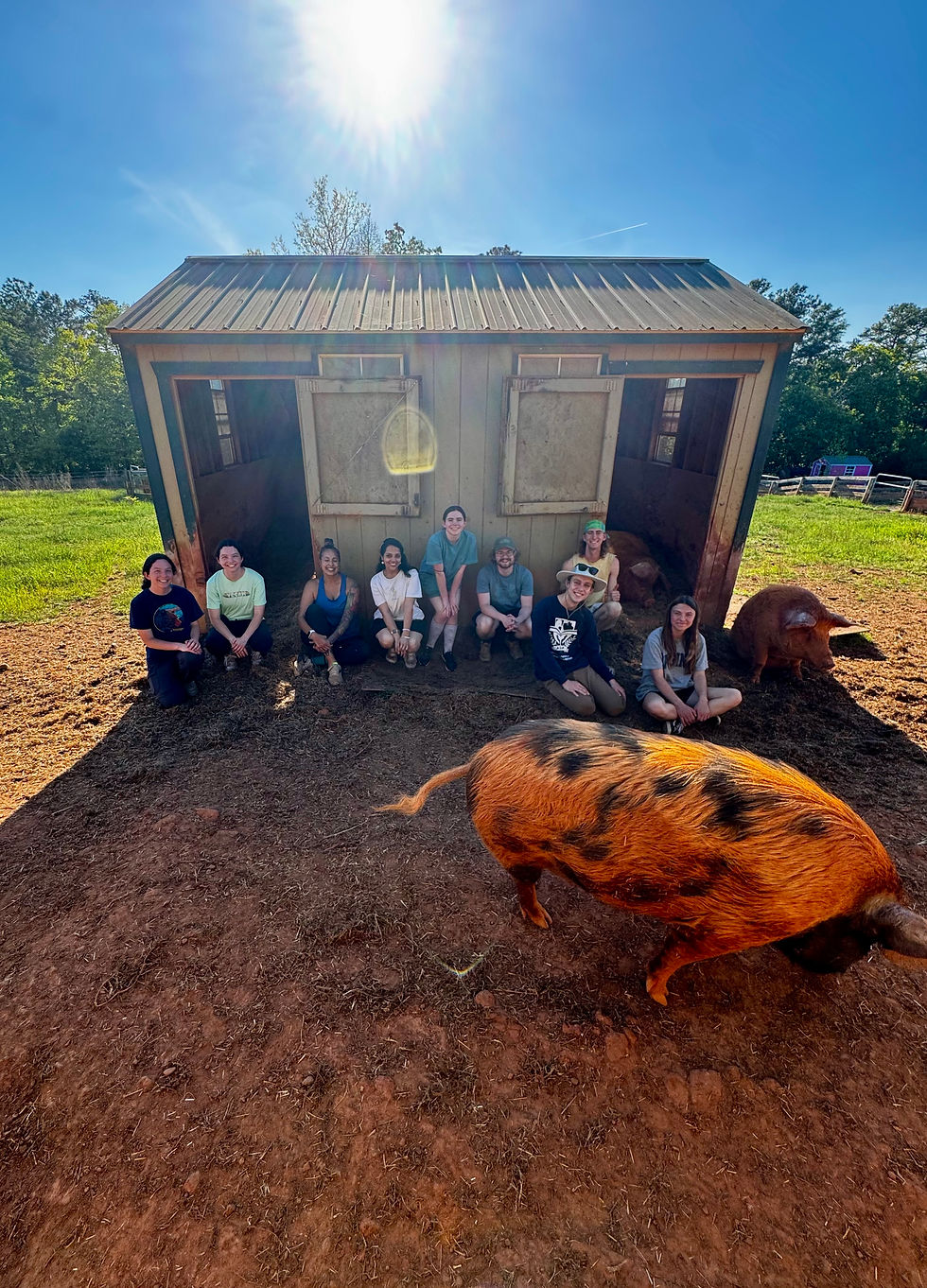
Sanctuary Day offers a moment to reflect on what it truly means to hold space for lives that were never meant to be reduced to use or outcome.
Across different landscapes and communities, sanctuaries exist with a shared purpose. Not as places of display or exception, but as environments where animals are given the opportunity to live fully as themselves.
At its core, sanctuary is a promise carried out daily through care, consistency, and presence. It is the ongoing work of building and maintaining systems that allow animals to move through the world in ways that feel natural to them, with autonomy over their lives and the ability to form relationships on their own terms.
This work is not abstract. It is physical, deliberate, and continuous. It is seen in the details that often go unnoticed, but shape everything: safe environments, proper nutrition, secure fencing, access to shelter, reliable water systems, thoughtful habitat design, vetrinary care, and the constant attention required to adapt as needs change over time.
But beyond infrastructure and daily care, sanctuary is also something quieter. It looks like relationships forming in their own time. Curiosity returning. Rest without fear.
It is in these moments that the purpose of sanctuary becomes clear.
We recognize the animals at the heart of sanctuary as individuals. Their lives are not defined by what they endured, but by who they are. Each one carries a depth that cannot be reduced to a category or species label. They shape their own lives within sanctuary, and in doing so, they reshape how they are understood by the people who encounter them.
This is where sanctuary extends beyond the boundaries of the land itself.

When animals are seen living authentically, something shifts. What was once distant or abstract becomes tangible. Individuals replace assumptions. Stories replace statistics. And with that, perception begins to change.

Sanctuary does not ask for that shift. It creates the conditions where it can happen naturally, through presence, truth, and connection.
The impact of that change reaches further than any single place. It moves outward through the people who witness it, influencing how animals are seen, spoken about, and ultimately, how they are treated.
Today, we stand alongside Farm Sanctuary in observance of their first Sanctuary Day. For more than four decades, their work has helped shape what sanctuary could be, demonstrating that farmed animals deserve protection, care, and recognition as individuals, and creating a foundation that so many others have been able to build upon.
At the same time, it is important to acknowledge the reality of this work.
Sanctuary work is demanding. It is physically intensive, emotionally complex, and often carried out with limited resources. There are moments that are heavy, uncertain, and difficult to navigate. The responsibility is constant, and the stakes are real.
And yet, it is also meaningful, joyous, beautiful, and deeply worthwhile.
To those doing this work across the world: you are seen. Your work matters. And if you have not heard it lately, it is valued.
What connects sanctuaries is not geography, size, or scale. It is a shared responsibility to ensure that the lives within their care are met with respect, attention, and integrity. That responsibility does not end at the fence line. It carries into the broader community, where the understanding of animals continues to evolve.
Sanctuary endures because people are willing to see differently.
And more importantly, because they are willing to let that understanding guide what they do next.